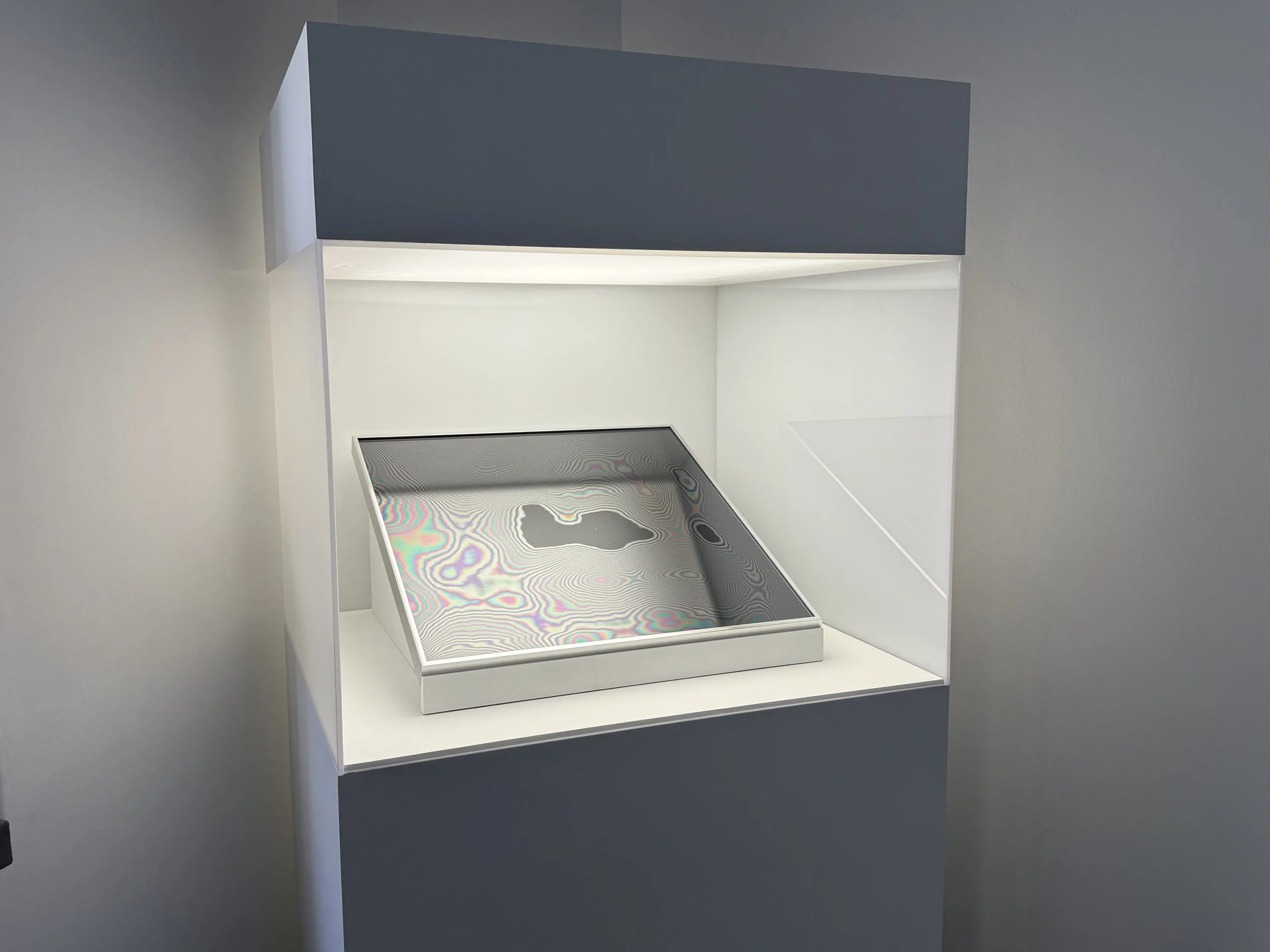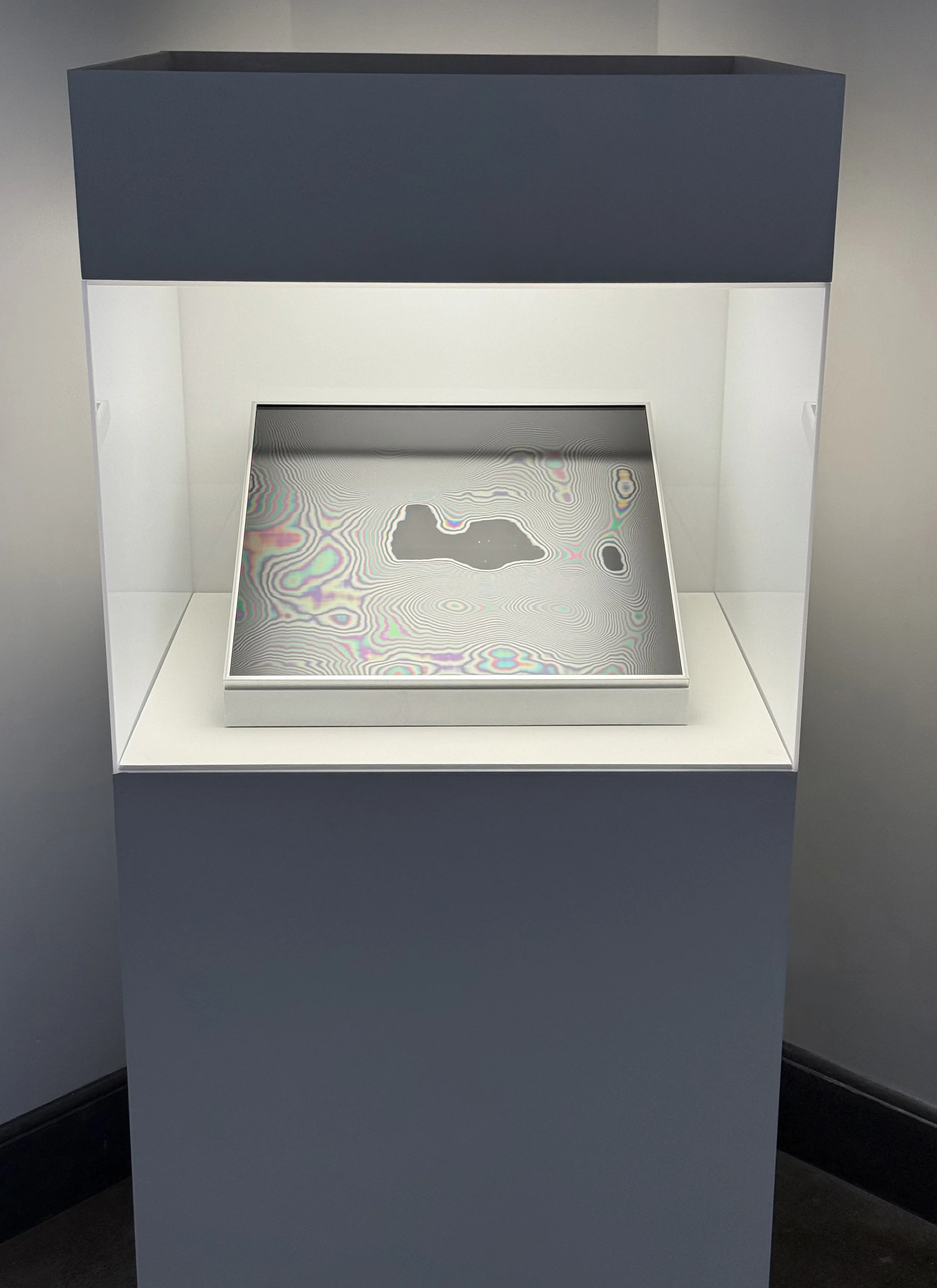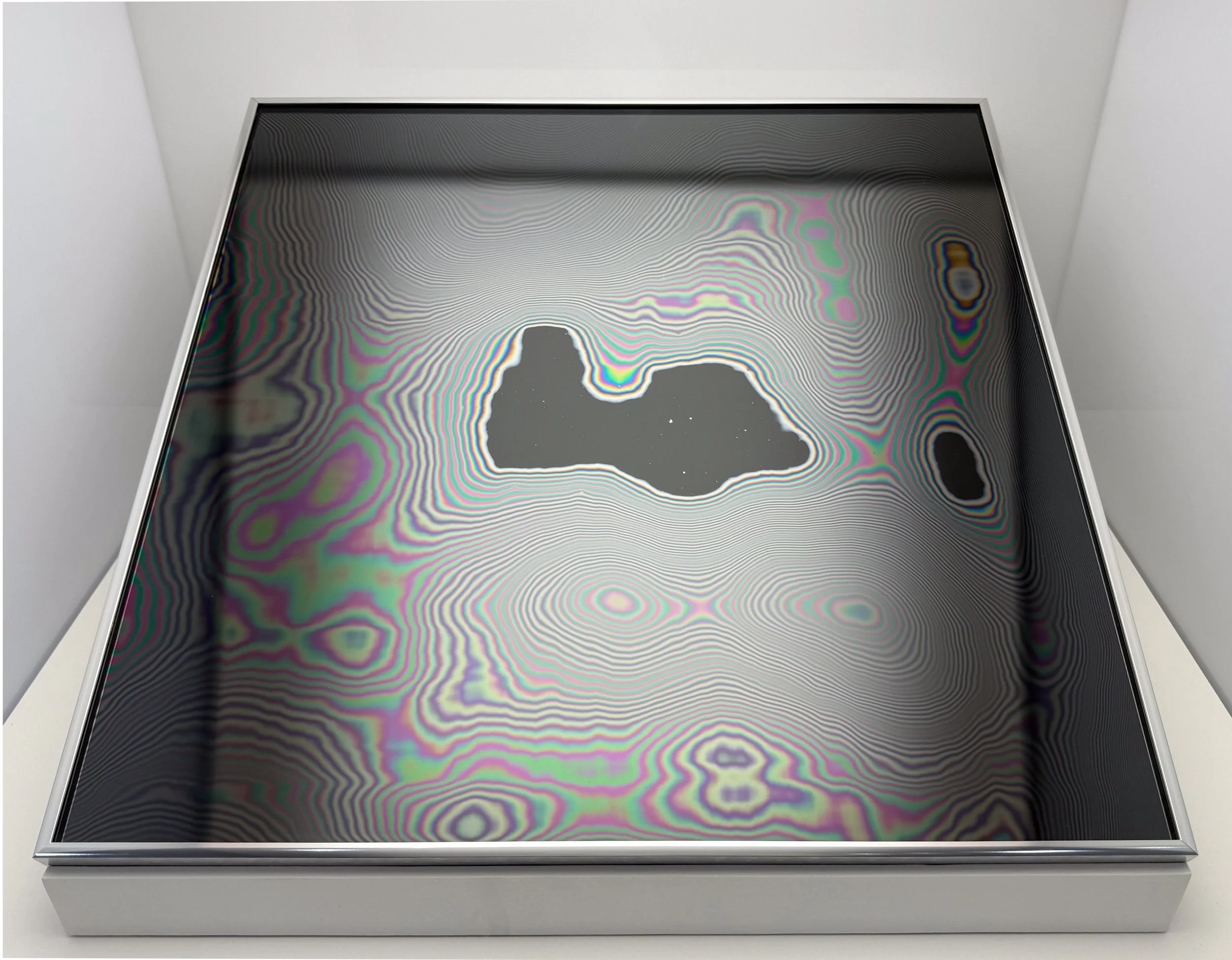
There is a process so elusive, so counterintuitive, that it borders on the miraculous: optical contacting. Developed for use in the most demanding conditions—deep space, where glue and resin would compromise clarity and fail under pressure—it relies on nothing more, and nothing less, than matter’s own tendency toward cohesion. When two planes of glass are ground to nearly perfect flatness, and brought into alignment, a faint pressure initiates a chain reaction of molecular embrace. They fuse, permanently, without adhesive.
Justin Ginsberg takes this near-invisible procedure and brings it into the field of visibility. By employing ordinary industrial architectural float glass—the kind that constitutes the windows all around us—he exposes its supposed uniformity as an illusion. Where two sheets do indeed meet, they bond irreversibly, forming dark, almost inky patches or islands. But in places where the glass retains microscopic undulations, air - the thickness of a wavelength of light - remains caught between the sheets. Under light, these infinitesimal pockets reveal themselves as Newton rings: concentric, spectral patterns that map the terrain of an unseen landscape (similar an oil slick revealing spectral color). The work is not only an exploration of material, but also of revelation—of making visible that which is usually hidden.
At its core lies a profound question: What does it mean to touch? For Ginsberg, touch is not simple contact, but an exchange of energy, photons flickering in and out of existence. The scientific phenomenon becomes metaphor: an exploration of our desire to bridge the spaces between us. In this sense, his practice sits at the fertile intersection of craft, science, and philosophy—taking an industrial technique and re-situating it as a poetic meditation on human connection.
The work is both homage and provocation. It honors the legacies of scientific ingenuity and artisanal precision that developed such processes in the first place, while also re-situating them as subjects for aesthetic inquiry. The result is a body of work that treats glass not only as a medium of architectural fabrication, but as a philosophical instrument—one that reflects and refracts questions of presence, connection, and perception.