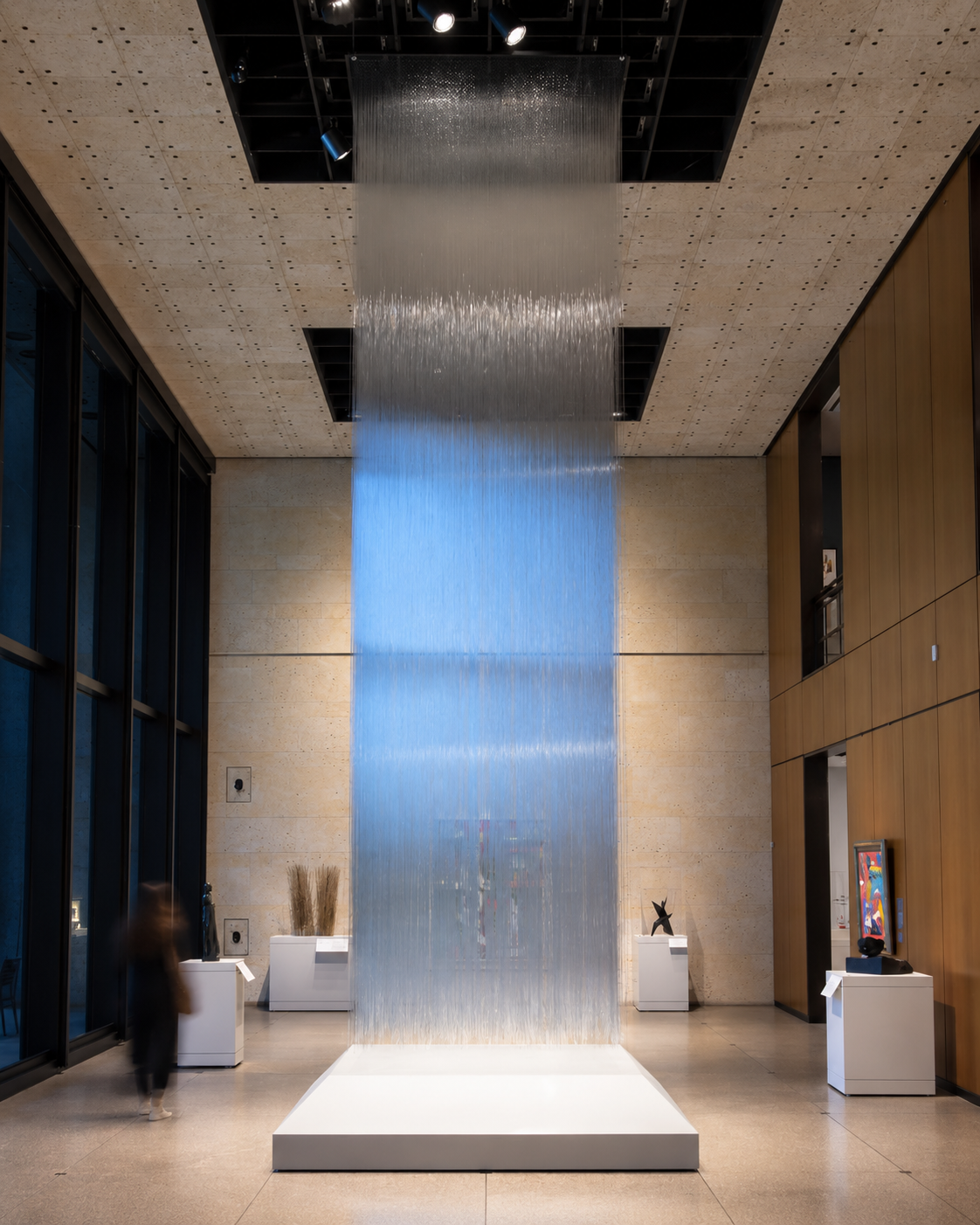
Sky Column: Shaking the Shadow

Sky Column: Shaking the Shadow
25’ x 10’ x 10’
Hand Pulled Glass Fibers
2022-23

Justin Ginsberg treats materials as a means of extending human perception toward what is too small or distant, too slow or fast, or simply too familiar to notice. The way a puddle holds a rainbow when oil has seeped from a vehicle, or hair-thin threads of glass carry our digital infrastructure through fiber-optic networks — whether encountered by happenstance or born from human ingenuity — remarkable phenomena become ordinary through familiarity. They grow so familiar, so seemingly known, that we rarely stop to consider the principles embedded within them.

Ginsberg constructs material conditions through which such phenomena can be physically encountered. Glass frequently serves as an instrument within this investigation, as do light, pressure, distance, time, and the particular conditions of a site.

Developed through more than 25 years of material experimentation, research, and collaboration with engineers, historians, scientists, museums, and industry, his work ranges from intimate objects to museum-scale and site-specific installations. He has drawn molten glass into fibers extending across distances as long as 150 miles, used optical interference to register microscopic topographies between surfaces that appear to touch, and constructed situations in which otherwise imperceptible physical relationships become available to experience.

Ginsberg earned his BA in American Studies and History from the University of Texas at Austin and his MFA in Studio Art from the University of Texas at Arlington, where he is Associate Professor and Head of the Glass Area. His work is held in the permanent collections of the Corning Museum of Glass, the Frye Art Museum, and Museum Kunstpalast in Düsseldorf. Solo exhibitions include the Amon Carter Museum of American Art, S12 in Bergen, Norway, and Traver Gallery in Seattle. His work has been featured in The New York Times and The Wall Street Journal and selected seven times for the Corning Museum of Glass's New Glass Review.