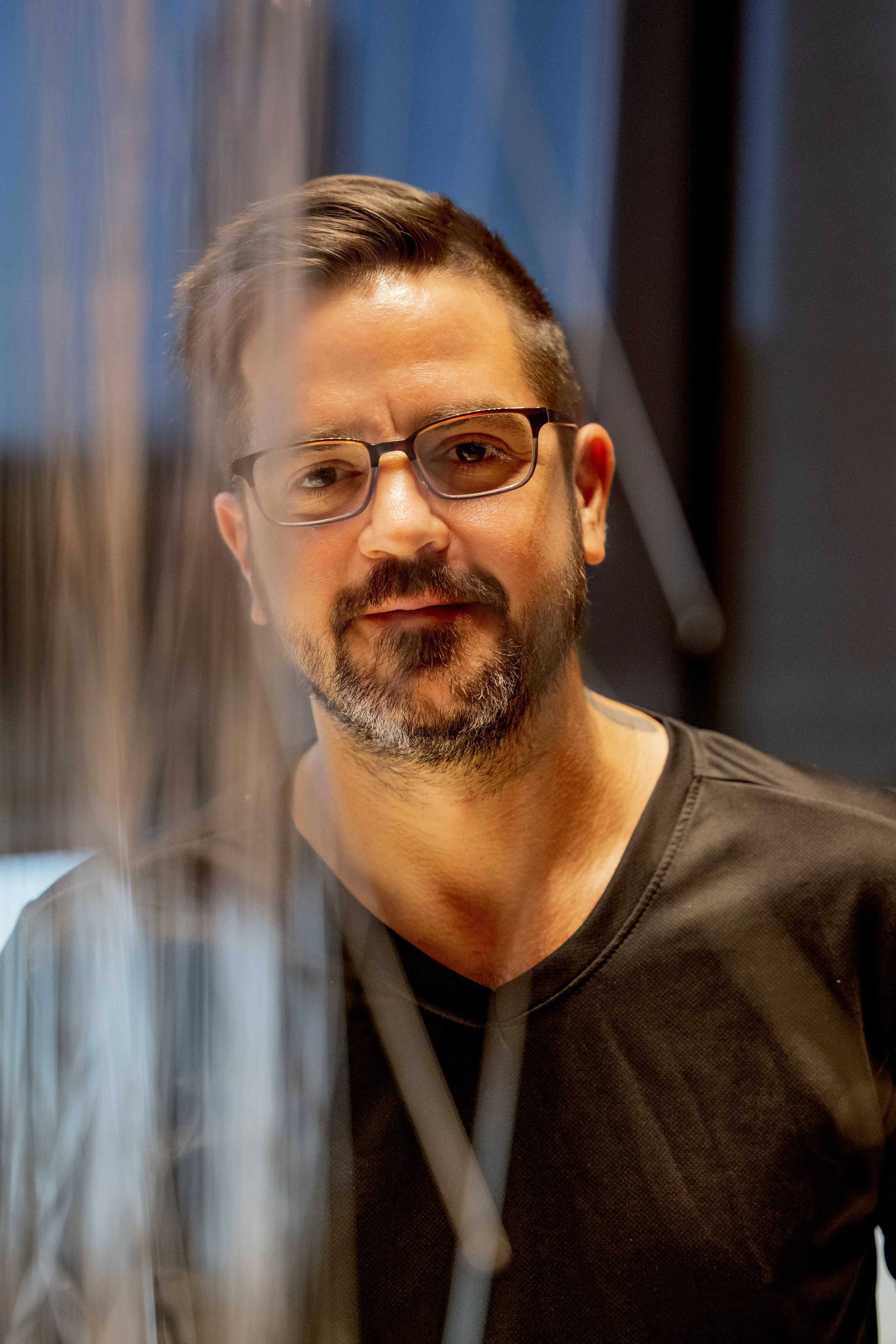
Justin Ginsberg (b. 1981) is an interdisciplinary artist, writer, curator, and educator born in Dallas and based in Dallas–Fort Worth. Drawing on more than 25 years of material experimentation and collaboration with engineers, historians, scientists, museums, and industry, he works in glass at every scale, from intimate objects to museum-scale and site-specific installations.
He has presented solo exhibitions at the Amon Carter Museum of American Art in Fort Worth, S12 in Bergen, Norway, Traver Gallery in Seattle, and Berlin Glas e.V. in Germany. His work is held in collections including Museum Kunstpalast in Düsseldorf, the Corning Museum of Glass, the Frye Art Museum, the Museum of Glass in Tacoma, the Museum of American Glass, and the Toyama Institute of Glass Art in Japan. It has been featured in The New York Times and The Wall Street Journal and selected seven times for the Corning Museum of Glass's New Glass Review.
His research has been supported through residencies, grants, and collaborations with the Corning Museum of Glass, the Chrysler Museum of Art, the Toledo Museum of Art, the Watermill Center, the National Science Foundation, the DESY particle accelerator, and the Alexander Tutsek-Stiftung, which funded his recent research into optical contacting in Berlin.
Ginsberg holds a BA in American Studies and History from the University of Texas at Austin and an MFA in Studio Art from the University of Texas at Arlington, where he is Associate Professor and Head of the Glass Area. He is completing a permanent public artwork for the City of Arlington and has upcoming exhibitions at the Museum of American Glass and the American University Museum in Washington, D.C.
ABOUT
A film of oil spreads across water and produces a spectrum. A thread of glass, bent around a corner, carries information across thousands of miles. One we've likely seen. The other we know is there. I construct conditions in which familiar properties of matter become newly perceptible. Within the work, light, pressure, distance, and transparency become active forces.
Glass is my central instrument, operating at scales from the microscopic to the transoceanic. For centuries it has mediated between the human body and what lies beyond its perceptual limits: the microscope, the telescope, and, more recently, the optical fiber. The more effectively glass performs this work, the less visible it becomes. I reverse that relationship.
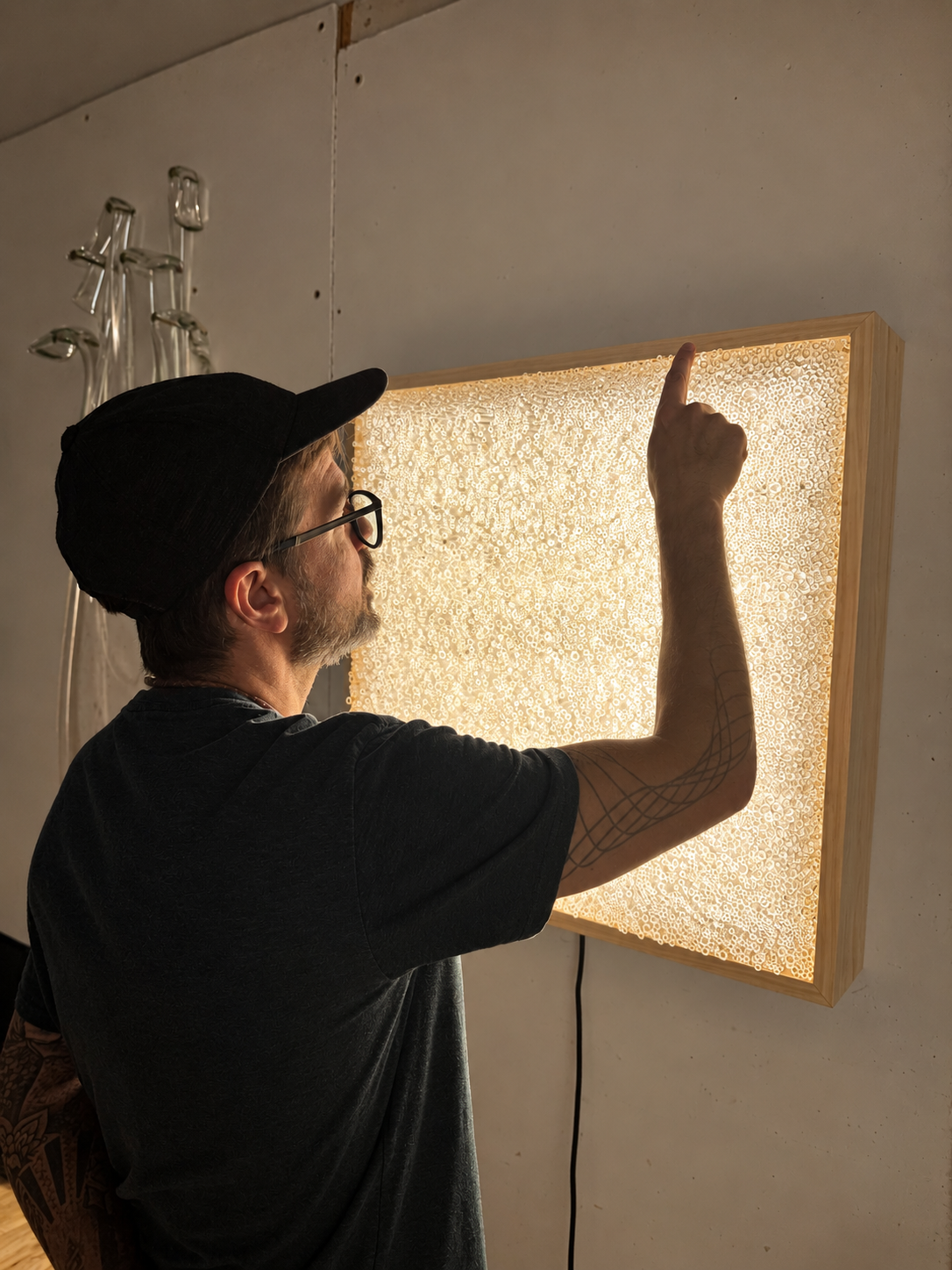
I gather molten glass on a rod, pinch it, and walk it out, step by step, across a kilometer, a mile, 150 miles, each fiber a marked trace of distance traveled. My body sets the pace, and the length of each fiber records how far I carried it before it cooled. Gathered by the thousands and suspended in space, as in Sky Column: Shaking the Shadow at the Amon Carter Museum of American Art, those individual journeys become a single column of light.
Other works operate at the opposite extreme of scale. Through optical contacting, a process I have researched in Berlin with support from the Alexander Tutsek-Stiftung, two polished sheets of glass join without heat or adhesive, held together by molecular attraction alone. Pressure becomes visible as color: where the sheets appear to touch, an interval smaller than a wavelength of light produces the same bands that shimmer across a soap bubble.
These methods come from industry and science. I work alongside engineers, historians, and scientists, and I am drawn to the moment a discovery leaves the laboratory and enters the world, where it can connect, measure, reveal, or be turned toward harm. Glass carries that history within it.
By making the overlooked perceptible, I position the viewer in the interval itself, between knowing something is there and meeting it.
Statement
Contact
Justin.elliot.ginsberg@gmail.com
Arlington, Texas
Instagram → justin_ginsberg_studios
For questions, commissions, exhibitions, and studio visits, please get in touch.