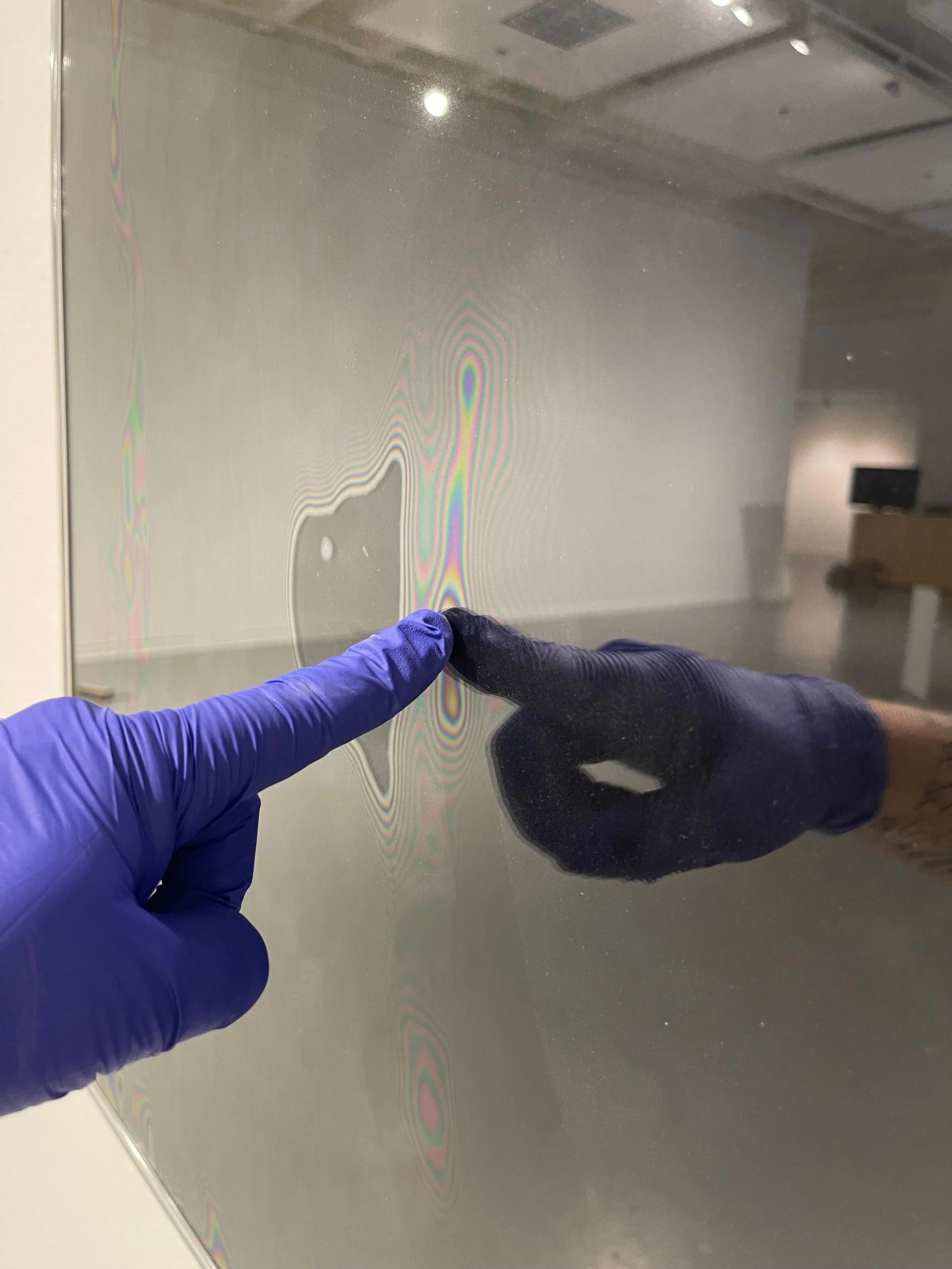

The Distance of Touch documents a four-week research and production residency at Berlin Glas e.V., held from June 9–July 10, 2026. Supported by the Alexander Tutsek Stiftung, the Charles T. McDowell Center for Global Studies at the University of Texas at Arlington, and NSG Pilkington Architectural Glass, the residency brought together nearly a decade of research into optics, material science, and sculpture.
At the heart of this research lies a deceptively simple question: how do invisible phenomena become perceptible? Throughout history, philosophers and scientists have returned to this problem. Light cannot be held, yet it reveals the world. Air surrounds us continuously, though we rarely acknowledge its presence until it moves. Float glass is engineered to disappear, directing our attention beyond the material itself.
This question ultimately led me to optical contacting. Developed for precision optics, the process joins two polished glass surfaces through molecular attraction alone, creating a permanent bond without altering their optical properties. Yet when ordinary float glass is brought into contact, microscopic variations in flatness trap an air layer only a wavelength of light thick. At this scale, interference patterns known as Newton rings emerge, revealing an interface of extraordinary sensitivity where light makes visible relationships inaccessible to every other sense.
Our understanding of reality depends as much upon these transparent mediators as upon the objects they disclose.
